Showing posts with label Physical Spaces. Show all posts

Monday, November 24, 2014

Modern Learning Environments Part Two

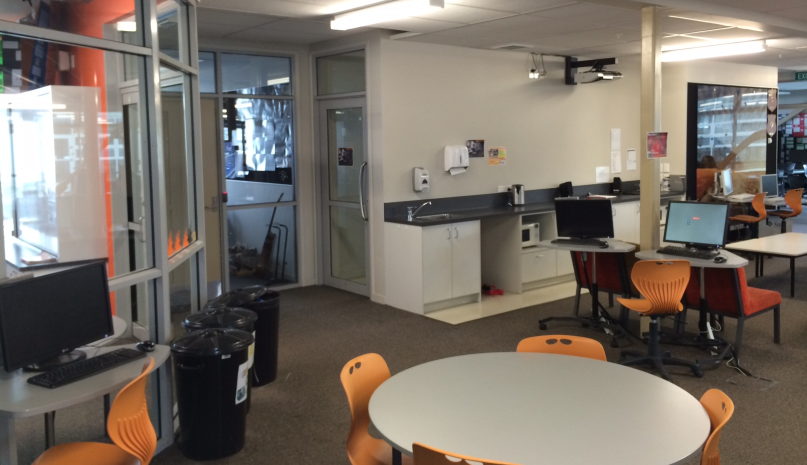
Break Out Space With Computers - Papamoa
School Visits
Over the last two weeks I have had the privilege of travelling to visit some recently constructed school blocks.  All of the modern Ministry of Education classroom blocks are in the format of large open spaces (there are no isolated classrooms being constructed anywhere).  
There are two key reasons for this.   The first is the practical/financial factor that there are fewer corridors and other such wasted spaces.  The second is the trend towards a more collaborative learning environment.   

Removable Walls - Papamoa
The first school we visited was Papamoa College.  This is a new school (currently in their fourth year).  They are a very similar school to us here at Waihi College.  Year 7-13, middle decile, with a similar demographic of Maori/Pakeha.  Papamoa College was created in response to the population growth in the Tauranga/Mount area.  Their common spaces are for year levels - all the science, maths, English and social studies taught in same space.  Four teachers all teaching year 9's and 10's in their 'house' groups.  

Open Plan Teaching Space - Papamoa
It is hard not to be impressed with the facilities at Papamoa.  They have a great physical environment located next to the Gordon Spratt reserve they have access to wide expanse of fields.  The school buildings are well appointed modern design angled for the sun.  The day we visited was a howling windy day - but inside you wouldn't have noticed. 

Papamoa College is also very similar to Waihi College in that they've adopted learning by inquiry and relevant context as their primary pedagogical driver.  They see the modern learning environment as a means of enhancing that style of learning.  

Learning Commons - Papamoa
Large Moving Doors - Te Kuiti
Our second school was Te Kuiti down in the King Country.  This is a smaller school only year's 9-13.  They have constructed a large space for three English teachers.  It was effectively three large classrooms and two 'breakout' spaces (each of which is probably big enough for a small class).  


There was a large communal staff work space/resource room and two internally accessed unisex toilets.  Two of the classrooms were plumbed for a water supply.  
Staff Workroom From Class - Te Kuiti
North Facing Deck - Te Kuiti

Te Kuiti's building was more traditionally styled and fitted in well with the current older buildings.  Papamoa College was definitely a modern style building.  Both were well fitted with modern technology in mind.  


The question for us here at Waihi College is what would work best for us here with our students?  We have the funding here for our new buildings (which will be two block each housing four classes) and work should begin late 2015.  It was great to take along Shannon and Fiona representing staff to gather their thoughts on the project.  

Thanks to both Te Kuiti High School and Papamoa College for the opportunity to come and see the schools.  Both of which were very impressive and spaces the students and staff can be proud of.  

This post relates to RTC # 7. "Promote a collaborative, inclusive and supportive learning environment."


Wednesday, November 19, 2014

Modern Learning Environments

Waihi College's New Block
You may be aware but we have just been granted by the MOE a little over $2 million to upgrade our classrooms here at Waihi College.  The intent is to replace the prefab buildings that make up P1 through to P10.  These will be replaced over two stages and replaced by two modern learning blocks.  
Modern learning environments are not actually that modern - the idea has come a long way from when we had the infamous 'Nelson Blocks' of the 70's.  

Here is a link to a post that I did when I visited Mission Heights Junior High in September with some photos of what they've created up there.  


Here are three videos on what the changing environment can do.  Although this is about an existing classroom not a new block it is a good watch.  

The first video is the set up of the situation.  Predominantly it made me realise that although P10 is an older prefabricated building in need of demolition - this guy had it harder (36 students in one classroom - ouch).  However when I watched I could see what looked very similar to the rectangle spaces we have here in New Zealand.  


The second video is about the transformation.  This is the one that made me think about my own space - especially made me think of when I started teaching and everything was in single desk rows.

The third video is the finished product.  The space was definitely an improvement and you can see that it is far more functional.  


So now as a member of staff you may not know if you're one of those who will be teaching in the new block when it is built.  But this is a good opportunity for you to consider the space you teach in currently.  Reflect upon the way that that space adds to the learning that is taking place.  Are there simple things that can be done to improve your learning space.  For example in that above videos the classroom was originally full of furnishings that had been accumulated over time - the space was cluttered and dysfunctional.  Clearing out space is a way to change that.  

This post relates to RTC # 7. promote a collaborative, inclusive and supportive learning environment

Sunday, September 7, 2014

Open Plan Collaborative Learning Environment

Learning Commons
It was my pleasure to spend a day up in Auckland visiting schools that have started down the collaborative learning environment pathway.  I was part of a delegation of 15 DP's from the Hauraki Cluster that travelled north. 

There were several goals for us in our journey...
  1. We wanted to see the possible set up of Waihi Colleges new classroom block (scheduled to replace the prefab classrooms P1 to P10).
  2. To investigate the idea of 'discovery learning' (autodidactic) - where the student undertakes self directed learning in areas that they are most passionate about - with the teacher linking the curriculum into that learning. 
  3. To investigate how staff team teach in a share learning common environment. 
  4. To pick up on any innovative, positive, alternative ideas.
The first stop off was at Mission Heights Junior High School.  MHJHS is a new school that has risen from farm land in the east of Auckland.  Predominantly their learners are from immigrant families (around 10% Pakeha or Maori).  The campus was build all in one go.  It may be fair to compare part of their main buildings with what we here at Waihi College will build next year (maybe 2016). 

Here are some of the exciting things that I took away from MHJHS...

Here is a learning common.  It is a larger open space (with ranchslider glass separators).  This one has four classrooms all feeding off the main central location.  In this picture you can see technology is centrally located - staff mingle their way through all rooms and work with all students. 


Here is the front of a typical classroom - there are no teacher desks or chairs - the drawers and cupboards under the whiteboard are the teacher desk.  There are glass doors connecting into the next door classrooms and (from where I took the photo) a large wall of glass into the common area. 
Note the chairs all have wheels and swivel - deliberate as "boys need movement". 


Here is a picture of a science lab - you can see that this too is another open space.


Each of the areas of the school had their own 'cafe' - there was no canteen rather students had access to water, microwave, tea/coffee.  It was all in the open so those that made mess couldn't just slip away.  There was also office space next door - in each of the common area there was office space for a DP - there was no "top corridor" rather the leadership team were located in the commons with the students. 


The computers were all run on these moveable stations - all the data is recorded on the students independent memory card.  These were a very cheap system ($175 each) - there was one computer for every two students.  This meant that MHJHS didn't have intention to go down the BYOD pathway.  To me it seemed that the students just quietly worked in books/pairs or were onto the computers. 


One of the most interesting decisions that MHJHS decided to do was to have a line in the timetable where students get four hours where they can choose their study (with guidance).  Teachers are able to offer 'interest' subjects - we saw lots of specialist sports, competition tuition, Afrikaans language classes, dance classes, skateboard tutor teaching tricks etc.  Every staff member offers their time to do their interest (plus one or two catch up classes).  The *catch up* classes were compulsory (2 out of the 4 periods) for students that are behind in a curriculum.  That way if a student is identified as being "below the level" they're expected to come to some curriculum classes instead of dance/music etc.


This post relates to RTC # 7. promote a collaborative, inclusive and supportive learning environment.  And RTC # 8. demonstrate in practice their knowledge and understanding of how ākonga learn part iii. encourage ākonga to take responsibility for their own learning and behaviour.


Tuesday, June 10, 2014

Forward Thinking on Education

Theme of this years conference - "Ideas, Innovation and Inspiration"

Re Thinking Educational Spaces

Mark Osbourne (former DP at Albany Senior High) presented on re-envisioning how schools could be set up without traditional physical constraints.   They created the high school from scratch and could do what ever they felt would be best...

The tried to think of how physical spaces effect relationships and learning. 


They created some interesting spaces. 
They rethought the idea of traditional
learning spaces. 


Larger open spaces for learning.
[shopping mall cafeteria style learning?]
60% off all the classrooms in NZ are over 40 years old. 


The question that we have for use at Waihi College is not so much lamenting the building we have.  But to consider the influence of the environments we establish in our classrooms to aid learning for our students.  Some interesting discussion that could be had here. 


Mark highlighted that statistically in classrooms "80% of the questions we ask in schools have alreadly got the answers" and he challenged us to think about our education being centred more around


Tony Wagner - The Global Achievement Gap
 
There are three cruicial changes...

1.  Knowledge is a commodity - it is free like air or water.
2.  What the world cares about is not what you know but what you can do with that knowledge, and,
3.  Any job that can be routine is rapidly being offshored or automated.