Showing posts with label 21st Century Education. Show all posts

Monday, May 9, 2016

Raising Student Achievement

Raising Student Achievement Through Targeted Actions

ERO produced a report at the end of 2015 which outlined for teachers (and school leaders) insights into effectively creating targets to accelerate students learning.  

This document represents a substantive analysis into what specific actions school leaders are taking to review the impact initiatives are having upon student progress.  The material specifically challenges management to justify their choices around measurable gains.  

I found this report to be extremely useful as it works through multiple aspects of education from BOT (governance level), through leadership, teacher and students/parents.  Many of the findings of the reports used case examples to juxtaposition success variations of strategies on less successful attempts.  

The importance of data is evident throughout this report.  The authors emphasising that schools are most likely to have the correct initiative/ideas in mind when planning change.  But often the success of these initiatives/ideas is inhibited by some simple failings.  The use of quality data (and by default reports) is a primary focus.  ERO challenges schools to strive to build up the capacity within staff for making improvements.  "The most significant difference between schools that succeeded and less successful schools was the explicit commitment to both equity and excellence." (p.36) 

This post is related to RTC #6. "Conceptualise, plan and implement an appropriate learning programme - i. articulate clearly the aims of their teaching, give sound professional reasons for adopting these aims, and implement them in their practice."  And ERO's School Evaluation Indicators Domain 2 Leadership of conditions for equity and excellence - "Leadership build capability and collective capacity in evaluation and inquiry for sustained improvement and innovation." 

Sunday, October 18, 2015

Book Review

Educating Ruby : What Our Children Really Need to Learn
by Guy Claxton and Bill Lucas.  

Guy Claxton and Bill Lucas are two of the worlds most prominent educational theorists.  Guy Claxton is best known as the guru behind the 'BLP - Building Learning Power' movement in the United Kingdom (and expanding).  

Educating Ruby (2015) is a modern view of the societal ills centered around education.  Like many current education material Claxton and Lucas are very interested in the bigger picture of education.  Why thinking about the meta idea of learning as opposed to curriculum or pedagogy.  Having been familiar with BLP (book review coming shortly) I found much of Educating Ruby to be a companion document.  

Whist this book is not specific to New Zealand's educational system (although some acknowledgements to our early childhood systems are made), Educating Ruby is equally valid reading for Kiwi teachers.  

A strong case for curriculum review is made by Claxton and Lucas in Educating Ruby where hegemonic thinking about the 'heirarchy' of subjects is raised:  “In school, subjects assume importance in inverse proportion to the amount of bodily activity they involve.  If you can stay clean and still while you are learning, that is good, so maths and English come out at the top of the pecking order.” (p. 51)  This is somewhat reflective of Waihi College's review of students vocational pathways.  

Strong criticism is made of the supremacy of testing in education, whilst the authors a making specific reference to the UK system, NCEA easily is reflective.    Teachers are under increasing pressures to get student through a myriad of assessments in 'preparation' for life after school.  Questions are raised about the 'depth' of modern testing methods.  Reference made to the work of Sugata Mitra and revolutionising what learning should be.  

This post relates to RTC#8. "Demonstrate in practice their knowledge and understanding of how ākonga learn." and RTC#7. "Promote a collaborative, inclusive and supportive learning environment." And ERO's School Evaluation Indicator - Domain Five : Professional Capability & Collective Capacity.

Wednesday, September 30, 2015

Book Review

Mindsets in the Classroom: Building a Culture of Success and Student Achievement in Schools. by Mary Cay Ricci

Mindsets in the Classroom is a well written book for school leadership and teachers alike.  It address Carol Dweck's (click here for book review) notions of fixed and growth mindsets.  Mary works from many angles, student/parent/teacher/administrator.  She presents a school wide systematic approach to embedding a growth mindset.  

In all honesty I have been working under the fixed mindset for the majority of my career.  With teaching of Mathematics I would regularly see the differences in students skill in my subject.  As I've aged I can see more that 'skill' is often exposure.  Those best at arithmetic most likely have had more exposure.  Reading more about growth mindset the more benefit I see it in for a school community.  

At it's heart growth mindset is about grit and determination.  Seeing the challenge of learning and not shying away.  I prefer a world where attitude takes you further than talent.

Mindsets in the Classroom begins by establishing the research on malleability of intelligence, quickly challenging educators to consider their own beliefs around IQ; “The first stop along the path to building a growth mindset culture is to begin to build a school culture that values intellectual growth with a staff who has internalized the belief that intelligence can be cultivated.” (p. 13)

Ricci uses real life examples to illustrate her points.  A significant section of Mindsets in the Classroom is written for parents.  Having three young ones I found this to be riveting reading and picked up some good tips.  “When adults praise what a child ‘is’ such as tall or smart, the child attributes their accomplishment to a fixed trait they were born with.  When adults praise actions or tasks that children ‘do’, the children attribute accomplishment with their own effort.” (p. 20)

There is a strong emphasis on quality pedagogy to complement growth mindsets.  Specifically Ricci is critical of teaching that doesn't offer differentiation.  That one of the core responsibilities of teachers it the ability to recognise the learning needs of the students and provide appropriate learning to those individuals.  Tying in well with this was a comprehensive section on formative assessment, how to best use it, manage the data and react to what it says.  

I enjoyed this book.  I found that Ricci's ideas are well considered and easily communicated.  I will use this and Dweck's material as key source for some staff professional development.  I would recommend this book to any teacher or parent.  

This post relates to RTC#8. "Demonstrate in practice their knowledge and understanding of how ākonga learn." and RTC#7. "Promote a collaborative, inclusive and supportive learning environment." 


Thursday, August 20, 2015

Know Thy Impact

As a part of a series of workshops on Visible Learning Plus (the supplementary material for John Hattie's seminal work).  This is the presentation that was made to staff in our afternoon meeting.  

The purpose here is to form a collective understanding of the shared practice here at Waihi College around use of assessment information.  

Being a teacher who uses quality data to inform our practice is a vital component of modern teaching.  But there is a genuine plethora of data available to staff and this can create issues around sifting through this information.  

Here is the powerpoint that was presented.  The key points are...


  1. Teachers should be responsive to the students needs. 
  2. We should be self reflective on our practice (are we making the difference - having an impact).
  3. There are a variety of types of assessment - each with their own purpose.  We should be using the full gambit to inform ourselves.
  4. This ties very well into 'Teaching as Inquiry' - which is a core component of our appraisal system and the Registered Teacher Criteria.  


Know thy impact 10th august 2015 from WaihiCollege


Here is a copy of the video that was presented. 

This post relates to RTC #6  "Conceptualise, plan and implement an appropriate learning programme." And RTC #8. "Demonstrate in practice their knowledge and understanding of how ākonga learn- i) enable ākonga to make connections between their prior experiences and learning and their current learning activities & iii) encourage ākonga to take responsibility for their own learning and behaviour."And ERO's School Evaluation Indicators Domain 4. "Assessment activities are inclusive, authentic and fit-for- purpose, providing relevant and meaningful evidence to evaluate the student's achievement and progress." 

Tuesday, June 2, 2015

Ohinemuri Schools' Festival of Education

Mind Frames of Change

Yesterday the Learning Leaders and I were lucky enough to head over to the inaugural Education Festival held at Paeroa College.  Our intent was to go and see the keynote address by Lynda Shanks from Cognition Education in Auckland.  Cognition are the educational providers for John Hattie's Visible Learning Plus.

Here is a summary of the key messages I took away from Lynda's presentation...

There are three main messages of change presented; 1.  What are visible learners?  2.  What are the mind frames of the teachers (are we change agents in education)?  3.  What system reform is required in schools?

The notion of building up a shared language of learning was key.  The question - when your students are asked "what was learning like today?" would they say "fun" or "busy" or would they be able to describe their learning?  This question was supplemented with video of students verbalising their experiences in the classroom.  

How is it that we collectively as Waihi College staff are going about embedding the language of learning within our students?  Do we have a 'way' of learning that is uniform, do our students know it, and is it best practice?

Lynda went through Stephen Covey (recommended author or the The 7 Habits of Highly Effective People) basic change model.  How is it that we as educators know that we've actually made an impact on the learning of our students?

  • See - School Culture, personal beliefs, and traditions.  
  • Do - School structure/policies/rules/programmes.
  • Behave - the results and effects (e.g. achievement results).

Lynda then moved into the purpose of the workshops on the day.  She encouraged all of us to see ourselves as the change agents for our schools.  To begin this through a series of self reflective questioning.  

  1. How am I doing with my students?
  2. Where am I going to next in my practice?
  3. How am I going to get there?
  4. What can I control as a teacher?
  5. Do we challenge all of our students in our classes?
  6. Do we plan lessons from different points of view (the most able or those struggling)?
  7. Do we fall into the habit of labeling students? 
Overall the presentation was great.  Lynda is clearly a communicator who is grounded in the experiences of the the classroom.  

This post relates to  RTC#8. "Demonstrate in practice their knowledge and understanding of how ākonga learn." and RTC#7. "Promote a collaborative, inclusive and supportive learning environment.


Monday, May 4, 2015

Self Reporting Grades Part ii)

Empowering Student's Learning

One of the most exciting presentations from the Visible Learning Summit from term one this year was the presentation by the Selwyn College leadership team.  

Selwise
Please take some time to have a look at the following video of Selwyn College.  It is a summary of their journey over the last six year (new Principal in 2008) with some dramatic improvements in their outcomes.  One of the things that was presented at the conference was the benefits of explicitly presenting the language of learning - as you watch take note of the ways visually that Selwyn College has deliberately presented this.  

They have formulated a shared level of learning 'advertising' that is the standard across the school.  Students are re-enforced this values and methods in all their class.  Selwyn College is deliberately teaching meta-cognitive strategies to students with the goal of making them better learners.  

Selwyn College was a finalist in the annual Prime Minister's Education Excellence Awards in: Excellence in Leading - Atakura Award in 2014.  Their NCEA results progressed from pass rates below 50% of students to consistently in the 90%.   


One of the major changes that Selwyn College went through was to try to empower their students to chart their own way through their learning.  The way that they did this was to supply the students a detailed (in student language) descriptor of what each level of the learning was.  That is they'd take the NZ Curriculum's Achievement Objectives (click here) and drill down to what that would mean in the classroom - with exemplar illustrations.  That way the student is empowered to know exactly where they are in their learning and what the next steps in their learning would/should be.  

This was identified by ERO here at Waihi College when they highlighted a next step in our journey being "Quality Assurance... monitoring student's progress with agreed parameters."
The idea here being that the student would be able to understand what it is that they know (where they are in the curriculum) and that they'd be able to see the next steps in their learning to move themselves forward.  This relates very well to John Hatties most influential (biggest effect size) factor in student achievement - 'Self Reported Grades' (click here for evidence).  

Here is John Hattie briefly presenting a summary of his meta study (about five mins)...

This leads us to consider the norms of practice here at Waihi College.  How is it that we're focussing our collective efforts to making learning more visible?   What habits and systems do we share as teachers here at school that empower our students to progress in their learning?  

This post relates to RTC #6  "Conceptualise, plan and implement an appropriate learning programme." And RTC #8. "Demonstrate in practice their knowledge and understanding of how ākonga learn- i) enable ākonga to make connections between their prior experiences and learning and their current learning activities & iii) encourage ākonga to take responsibility for their own learning and behaviour."

Tuesday, April 21, 2015

Improving NCEA Results

James Cook High School

James Cook High School in Manukau South Auckland is a larger school than Waihi College (1200 students year 9-13 as opposed to our 500).  They have had a very remarkable story of turning around their qualification results for their students.

The were featured in the New Zealand Herald in the school holidays (click here for that article).  Some of the interesting comments in that article was what their Principal Vaugh Couillault had to say;

Mr Couillault, who joined the school in 2012, says the results are indicative of serious amounts of work from teaching and support staff, who deal with kids who come to the school usually well below standard.
"At year nine, our kids are up to four years below where they should be," he says. "And it takes a lot of hard yakka to help them from there."
He hints at some of the interventions that James Cook High teachers put into place for their students;

It's about making a real effort to know our learners. Not about just standing up the front. But any teacher worth their salt will be doing that."
They also collect "hard core" data, and can make changes on almost a daily basis around what is and isn't working, he says.

Last night there was a report on TVNZ's One News on the increased results (up from 42% of students in year 11 getting Level One 2014 up to 95% in 2015).

Here is a copy of that report (intellectual property of TVNZ)...[takes a min to load]


James Cook High School is a good example of how a school can work towards a collective goal of increasing the qualification results of their students.  I find myself interested in the finer details around the changes they have put in place.  Here is a summary of the main points...

  1. Perseverance - teachers not giving up on the kids (further opportunities) and kids not giving up (coming in in their holidays).
  2. Re-looking at the middle management - splitting up teachers into smaller groups to increase accountability around results.  
  3. Sense of Pride - looking at giving the student more pride in the community (including uniform etc).  Modernising the look of the school.  
  4. Face lift - The school had new building programme (Waihi College is due new block to replace P Block).  
  5. Student Centered Learning - getting personalised in the learning.  Identifying the needs of each individual student and getting the learning individualised.  


"I want every student that walks out the gate to simply be in charge of what happens to them next." - Vaugh Couillault

This post relates to RTC #6. "Conceptualise, plan and implement an appropriate learning programme i. articulate clearly the aims of their teaching, give sound professional reasons for adopting these aims, and implement them in their practice." And RTC #11. "Analyse and appropriately use assessment information, which has been gathered formally and informally i. analyse assessment information to identify progress and ongoing learning needs of ākonga 
ii. use assessment information to give regular and ongoing feedback to, guide and support further learning, iii. analyse assessment information to reflect on and evaluate the effectiveness of the teaching." 


Sunday, March 29, 2015

Self Reporting Grades Part i)

Students Self Reporting Grades

On Friday last week Vicky, Jo, Leon and I were lucky enough to make the trip up to Auckland to hear John Hattie speak at the Visible Learning Plus summit.  John Hattie has forged a strong reputation as one of the world premiere educationalists and is in high demand around the globe.   

I have reviewed one of his books Visible Learning for Teachers : Maximising Impact on Learning.  Here is a link to my review (click here).  Here is a link to the Visible Learning website (click here).

Previously most pd has been focussed around the things that teachers can do to best maximise the learning in the classroom.  Such as providing formative assessments, reciprocal teaching and feedback.

One of the key messages from the summit was that teachers should also look at the effective means available to students themselves.  Interestingly these are quantifiable more beneficial to learning than what the teachers can influence (aka getting the students flying themselves is better than teachers driving).

Here is the same diagram but looking at the strategies that the student is in control of...


At the conference there was much made of the 'self-reported grades'.  At an effect size of 1.44 this equates to over three times as much progress as just aging.  Or 50% more effective than formative evaluation.  

How is it that we can get our Waihi College students to be better at self-reported grading?  Is it enough to just get the students to judge themselves as "N", "A", "M" or "E"?

Primarily it is about having the students moved more towards become auto-didactic.  Being able to be their own teachers.  

Historically the system has been that teachers have been the gatekeepers of knowledge and would typically drip feed that knowledge out in the classroom.  Students would sit assessments at times where the teacher had confidence that the students have 'received' enough learning.  Sometimes teachers would have little appreciation of whether the learning had actually taken place.  

Hattie was interested in having the learning become 'Visible' - that is the students can explicitly see their progression through the content.  Question - what would that look like here at Waihi College?


This post relates to RTC #6  "Conceptualise, plan and implement an appropriate learning programme." And RTC #8. "Demonstrate in practice their knowledge and understanding of how ākonga learn- i) enable ākonga to make connections between their prior experiences and learning and their current learning activities & iii) encourage ākonga to take responsibility for their own learning and behaviour."


Thursday, March 19, 2015

Creating Innovators

Book Review

Creating Innovators : The Making of Young People Who Will Change the Word.  By Tony Wagner

I found this book a very enjoyable read.  I have read another good book by Tony called The Global Achievement Gap which was an educationalist's view of the world around the Global Financial Crisis of 2008.

The thing that most surprised me was that Creating Innovators is a book that is intrinsically linked to a website (click here for link) with videos that drive the writing within each chapter..

Tony identifies the key set of skills and habits of mind that modern students need to thrive in the world.  Those are;

  1. Curiosity,
  2. Collaboration,
  3. Associated and Integrated Thinking (aka adaptability), and,
  4. Taking action (experimenting).  
Chapter Five was the most interesting for me as a teacher in a high school.  Here Tony works through the conservative nature of education within modern secondary schools.  He highlights the traditional nature of education was based upon facts, but that there is an exponential growth in the amount of facts.  Primarily he challenges secondary teachers to seek new ways of finding relevance and meaningful connections with their students.  Ideally creating within our students the development of passion and purpose in their learning.

Much of the lament of Tony's comments on the American education system (over emphasis on testing and a highly specified curriculum) are things that New Zealand schools don't face.  Our NZC opens up the opportunity for teachers to innovate their learning into wide contexts.

Another wee gem in Creating Innovators is the 'letter to a young innovator' - five pages at the end of the book where Tony writes directly to modern day learners.  Here he offers advice to young people about the opportunity and importance of becoming more and more innovative.

I would recommend this book to any teacher interested in the 'big picture' of education.  It is an interesting read (one you'll have to do with access to the internet).  It was a readable book, one that you can digest over a weekend.  If I had any critique it was that it was too intercontinental United States.

This post relates to RTC#8. "Demonstrate in practice their knowledge and understanding of how ākonga learn." and RTC#7. "Promote a collaborative, inclusive and supportive learning environment."


Sunday, February 15, 2015

New Entrant Parents Want

Enrollment Interviews

One of the most enjoyable parts of my role last year was meeting the year six students and families as they came to the College for their enrollment interviews.  It is amazing how positive and excited the students (and parents) are about starting their time here at Waihi College.  

I have a series of questions that I work through with the families about what makes them tick.  One of the best questions is to ask the parents what it is that they really want for their child over the next seven years.  

Here are a collection of their responses.  The key thing that really stands out for me is how precious their children are to them and how high their hopes are for quality meaningful education.   


This post relates to RTC #1. establish and maintain effective professional relationships focused on the learning and well-being of ākonga.  And RTC #7. promote a collaborative, inclusive and supportive learning environment

Wednesday, November 19, 2014

Modern Learning Environments

Waihi College's New Block
You may be aware but we have just been granted by the MOE a little over $2 million to upgrade our classrooms here at Waihi College.  The intent is to replace the prefab buildings that make up P1 through to P10.  These will be replaced over two stages and replaced by two modern learning blocks.  
Modern learning environments are not actually that modern - the idea has come a long way from when we had the infamous 'Nelson Blocks' of the 70's.  

Here is a link to a post that I did when I visited Mission Heights Junior High in September with some photos of what they've created up there.  


Here are three videos on what the changing environment can do.  Although this is about an existing classroom not a new block it is a good watch.  

The first video is the set up of the situation.  Predominantly it made me realise that although P10 is an older prefabricated building in need of demolition - this guy had it harder (36 students in one classroom - ouch).  However when I watched I could see what looked very similar to the rectangle spaces we have here in New Zealand.  


The second video is about the transformation.  This is the one that made me think about my own space - especially made me think of when I started teaching and everything was in single desk rows.

The third video is the finished product.  The space was definitely an improvement and you can see that it is far more functional.  


So now as a member of staff you may not know if you're one of those who will be teaching in the new block when it is built.  But this is a good opportunity for you to consider the space you teach in currently.  Reflect upon the way that that space adds to the learning that is taking place.  Are there simple things that can be done to improve your learning space.  For example in that above videos the classroom was originally full of furnishings that had been accumulated over time - the space was cluttered and dysfunctional.  Clearing out space is a way to change that.  

This post relates to RTC # 7. promote a collaborative, inclusive and supportive learning environment

Monday, September 22, 2014

DEEP Learning Programme

Discover, Enrichment, Essential, Passion
One of the areas of discussion on our senior planning retreat was the notion of using our Learning Advisory time in an alternative fashion. One of the more intriguing ideas from the Hauraki DP cluster trips to Auckland was the Mission Height Junior College's DEEP programme.

When I first heard of the DEEP programme I immediately thought of the 'elective' programme many schools currently use.  However as I understood more of the DEEP programme the more I could see that it had significant differences to electives.

Primarily the programme was presented as the "main reason students are passionate about their day at school".  That the combination of autonomy of learning, concentrated remedial learning, individualised attention and shared passions/interests were attainable without adversely impacting upon traditional curriculum coverage.

Here is the presentation I gave for morning PD this week.


This post relates to RTC #5. "show leadership that contributes to effective teaching and learning." 

Sunday, September 7, 2014

Open Plan Collaborative Learning Environment

Learning Commons
It was my pleasure to spend a day up in Auckland visiting schools that have started down the collaborative learning environment pathway.  I was part of a delegation of 15 DP's from the Hauraki Cluster that travelled north. 

There were several goals for us in our journey...
  1. We wanted to see the possible set up of Waihi Colleges new classroom block (scheduled to replace the prefab classrooms P1 to P10).
  2. To investigate the idea of 'discovery learning' (autodidactic) - where the student undertakes self directed learning in areas that they are most passionate about - with the teacher linking the curriculum into that learning. 
  3. To investigate how staff team teach in a share learning common environment. 
  4. To pick up on any innovative, positive, alternative ideas.
The first stop off was at Mission Heights Junior High School.  MHJHS is a new school that has risen from farm land in the east of Auckland.  Predominantly their learners are from immigrant families (around 10% Pakeha or Maori).  The campus was build all in one go.  It may be fair to compare part of their main buildings with what we here at Waihi College will build next year (maybe 2016). 

Here are some of the exciting things that I took away from MHJHS...

Here is a learning common.  It is a larger open space (with ranchslider glass separators).  This one has four classrooms all feeding off the main central location.  In this picture you can see technology is centrally located - staff mingle their way through all rooms and work with all students. 


Here is the front of a typical classroom - there are no teacher desks or chairs - the drawers and cupboards under the whiteboard are the teacher desk.  There are glass doors connecting into the next door classrooms and (from where I took the photo) a large wall of glass into the common area. 
Note the chairs all have wheels and swivel - deliberate as "boys need movement". 


Here is a picture of a science lab - you can see that this too is another open space.


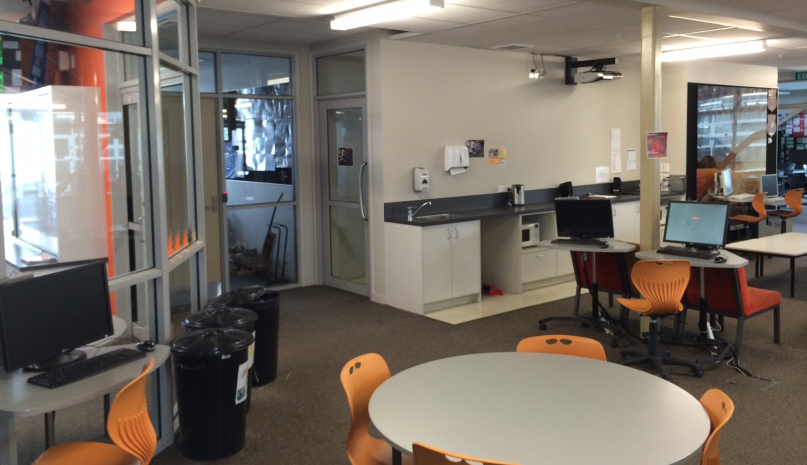
Each of the areas of the school had their own 'cafe' - there was no canteen rather students had access to water, microwave, tea/coffee.  It was all in the open so those that made mess couldn't just slip away.  There was also office space next door - in each of the common area there was office space for a DP - there was no "top corridor" rather the leadership team were located in the commons with the students. 


The computers were all run on these moveable stations - all the data is recorded on the students independent memory card.  These were a very cheap system ($175 each) - there was one computer for every two students.  This meant that MHJHS didn't have intention to go down the BYOD pathway.  To me it seemed that the students just quietly worked in books/pairs or were onto the computers. 


One of the most interesting decisions that MHJHS decided to do was to have a line in the timetable where students get four hours where they can choose their study (with guidance).  Teachers are able to offer 'interest' subjects - we saw lots of specialist sports, competition tuition, Afrikaans language classes, dance classes, skateboard tutor teaching tricks etc.  Every staff member offers their time to do their interest (plus one or two catch up classes).  The *catch up* classes were compulsory (2 out of the 4 periods) for students that are behind in a curriculum.  That way if a student is identified as being "below the level" they're expected to come to some curriculum classes instead of dance/music etc.


This post relates to RTC # 7. promote a collaborative, inclusive and supportive learning environment.  And RTC # 8. demonstrate in practice their knowledge and understanding of how ākonga learn part iii. encourage ākonga to take responsibility for their own learning and behaviour.