Showing posts with label 12RTC's. Show all posts

Sunday, September 6, 2015

Curriculum Progression

Aroha Heaslip from Evaluation Associates.

Vicki Spiers and Verna Littlejohn returned from an 'OTJ' workshop in Tauranga speaking very highly of a strong message presented by a quality presenter.  This is how I was introduced to Aroha.  


Aroha Heaslip
Evaluation Associates are a independent educational consultancy which is based in Auckland (Aroha heads the Tauranga branch).  Their main current contracts are focused on...

  1. Modern Learning Environments
  2. Assessment For Learning
  3. Maori Medium 
Aroha educational background is very wide, working in mainly in Secondary, with a little of Intermediate, Co-curricular and establishment of a full immersion Kura Kaupapa.  
The main message of today's presentation was around - having the learning as the 'captain' of their own education.  That being questioning how we can empower our students to be active navigators of their learning.  

What are the things that act as a barrier for students to operate with self efficacy in their learning?  Typically this will be specific limitations around the individual students level of literacy.  

What is our awareness as a community of students about the progression of akonga from our feeder schools?  What are the implications exist for those students if they arrive at Waihi College and 'start from square one'?  

The reflection of the presentation is found in 'front end' of the NZC where 'Effective Pedagogy' is outlined; 


Aroha based much of her foundation of her discussion about what Waihi College presents in our prospectus and website about what is important in education here at school.  

A core part of Aroha's workshops activities 'Coherence at Our School' - where staff divided into smaller groups and work through the shared understanding of how things are done here at Waihi College.  
  • How do we make available the information about our tamariki?  Can we sharpen up our lines of communication?
  • The use of exemplar materials - spelling out the steps through the curriculum.  Our teachers know what "level four" looks like - but do our students? 
  • How can we get the staff to act consistently in a student centered manner?  
  • How do we make explicit use of learning intentions and success criteria?  
  • What are the core learning that needs to be the basis of education here at Waihi College (example of the use of being able to write coherent paragraphs)?  
The latter part of the presentation we were presented with an open ended invitation - "What are the next steps that can be targeted for our community to move towards in the immediate future?"
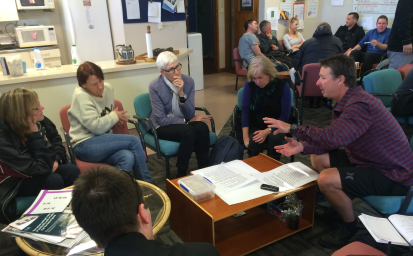
  • More access to the information (say with a rotated option class) knowing a little bit more about the group before we have them. (Bob's group)  
  • How can we extend success some teachers are having with certain students to be shared success with all teachers? (Aroha's observation)  
  • How can we increase the parental/whanau buy-in to education? (Levonne's group)
  • Exemplars on the walls - students who say "why didn't I get a merit?" after the assessment - this should/could have been presented earlier to empower that student.  (Peter's group) 
  • We could be talking more between groups. (Bridget's group) 
  • Use of the APP's task being a more deliberate method of presenting shared understanding.  (Norm's group).
  • If we can't see it how can the kids?  (Jo's group)
  • How can we improve the collaboration with the feeder primary schools - can this proactively be acted upon? (Sean's group)
  • What about the 'uncontrollable' (e.g. truancy)... can our systems be improved?  How can we make our flagging of issues more ready actionable?  (Carlene's group)
  • Developing of Ako meetings - especially in the start of the year.  (Jay's group).
  • Shared rubrics/exemplars across the learning areas.  (Jay's group).

     
Archway of Teaching Capacity

n.b Aroha's presentation was through an online program called 'Sway' this is a free product available from Office 365. 

This post relates to RTC #7. "Promote a collaborative, inclusive and supportive learning environment."  And ERO's School Evaluation Indicators Domain 4 "Responsive Curriculum, Effective Teaching and Opportunity to Learn - students develop learning to learn capabilities."


Wednesday, April 1, 2015

Teaching As Inquiry 2015

Personal Inquiry

From the OneNote document
One of the important parts of our own personal development is to undertake our own 'teaching as inquiry'.   Lots of people over think this and put teaching as inquiry as something mystical.  This is not that case at all - rather it is about unpacking the thoughts you have on your impact in the classroom.

There are two places where Waihi College appraisal addresses teaching as inquiry.  I've also made previous postings on this blog on this topic (click here for the link).

This year we will attempt to focus our teaching as inquiry into one of our PLG's (so this can be from our first one - now to July or our second one - July to Dec).  I've had a few queries around this so I thought that I'd offer some options for staff.

  1. If you are feeling confident on conducting your own Teaching as Inquiry - then feel free to make a start on that (if you haven't already). 
  2. I'd put out there my own inquiry as a template for staff to see what it's about.  
  3. Create a generic inquiry that can be used by staff (this is my least preferred option - but should create more comfort for staff around this).  
Remember that Teaching as Inquiry is enshrined in the New Zealand Curriculum Document (click here for the link) and it is also the focus of RTC #12  (click here for that link).   Remember that teaching as inquiry should always be focused on your practice of teaching and/or the students learning in class.

This post relates to RTC #12. "Use critical inquiry and problem-solving effectively in their professional practice."


Sunday, March 29, 2015

Self Reporting Grades Part i)

Students Self Reporting Grades

On Friday last week Vicky, Jo, Leon and I were lucky enough to make the trip up to Auckland to hear John Hattie speak at the Visible Learning Plus summit.  John Hattie has forged a strong reputation as one of the world premiere educationalists and is in high demand around the globe.   

I have reviewed one of his books Visible Learning for Teachers : Maximising Impact on Learning.  Here is a link to my review (click here).  Here is a link to the Visible Learning website (click here).

Previously most pd has been focussed around the things that teachers can do to best maximise the learning in the classroom.  Such as providing formative assessments, reciprocal teaching and feedback.

One of the key messages from the summit was that teachers should also look at the effective means available to students themselves.  Interestingly these are quantifiable more beneficial to learning than what the teachers can influence (aka getting the students flying themselves is better than teachers driving).

Here is the same diagram but looking at the strategies that the student is in control of...


At the conference there was much made of the 'self-reported grades'.  At an effect size of 1.44 this equates to over three times as much progress as just aging.  Or 50% more effective than formative evaluation.  

How is it that we can get our Waihi College students to be better at self-reported grading?  Is it enough to just get the students to judge themselves as "N", "A", "M" or "E"?

Primarily it is about having the students moved more towards become auto-didactic.  Being able to be their own teachers.  

Historically the system has been that teachers have been the gatekeepers of knowledge and would typically drip feed that knowledge out in the classroom.  Students would sit assessments at times where the teacher had confidence that the students have 'received' enough learning.  Sometimes teachers would have little appreciation of whether the learning had actually taken place.  

Hattie was interested in having the learning become 'Visible' - that is the students can explicitly see their progression through the content.  Question - what would that look like here at Waihi College?


This post relates to RTC #6  "Conceptualise, plan and implement an appropriate learning programme." And RTC #8. "Demonstrate in practice their knowledge and understanding of how ākonga learn- i) enable ākonga to make connections between their prior experiences and learning and their current learning activities & iii) encourage ākonga to take responsibility for their own learning and behaviour."


How To Update Your OneNote Appraisal Documents

Hope that this helps...

This is a step by step tutorial to help you with getting the technology sorted.  I'm anticipating there are still some technophobes who it probably is best to come and see me for a couple of mins.

This video is about just copying and pasting from OneNote.  This is probably the easier of the ways to do this job (although you'll have the notes you've made from 2014 that will need overwriting).  


This is another video showing you step by step.  This one here is from the email that  your appraiser would have sent to you.  


This post was actually some PD for me as I used a new software called Open Boardcast Software.  It was actually pretty easy and I'd recommend it.  

This post relates to appraisal and tracking  your progress through the RTC's

Sunday, March 15, 2015

NZTC and EDUCANZ

NZTC (EDUCANZ) Discipline Tribunal Hearing

Here are some case examples from the last 12 months from NZTC.

Here teachers have had to appear before the Tribunal to go through some issues around professional boundaries.


\

Here are some instances where you might want to discuss the 'greyness' of relationships with students...

  1. Going to the pub (not in school time) and there is a student (over 18) there.  Is it ok for that student to buy the teacher a beer?  Is it ok for the teacher to buy that student a beer?
  2. Socialising after hours.  Say if there was a male staff member going for a training run with a student, just the two of them, in their weekend?
  3. Solo tutoring subject material male staff member female student?  
  4. Social media (Facebook) staff ‘befriending’ students (setting such that they can see each other’s personal settings)?
  5. Staff who comment socially online about the social lives of students (such as discussion around their relationships)?  
  6. Texting students personal mobiles after hours (late night texting about courses/assignments)? 
This post is to do with RTC #1. "Establish and maintain effective professional relationships focused on the learning and well-being of ākonga." and RTC#2. "demonstrate commitment to promoting the well-being of all ākonga i. take all reasonable steps to provide and maintain a teaching and learning environment that is physically, socially, culturally and emotionally safe."


Tuesday, August 26, 2014

Anti Bullying Message

Revolution Tour Group
This week we had a visit from an Auckland based tour group called "Revolution".  They are musicians that are travelling the country combining their musical talents with a strong anti-bullying message. 

They put on a show for an assembly of year 7's to 10's. 

Students chanting "stop the bull"

The effect of bullying on learning cannot be overstated.  Students who are victims of bullying will find it very hard to associate school as a positive place to be. 


Students ask to stand if they don't want bullying. 
As educators we have to give some real consideration to the level of safety we provide in our classrooms and around the school grounds.  This is more than just a social responsibility we are charged as professionals for ensuring this takes place. 


The Registered Teachers Criteria has two specific criteria that relates to this...
RTC #2 Demonstrate commitment to promoting the well-being of all ākonga - take all reasonable steps to provide and maintain a teaching and learning environment that is physically, socially, culturally and emotionally safe.  and
RTC # 7. promote a collaborative, inclusive and supportive learning environment - foster trust, respect and cooperation with and among ākonga.  
Good music - strong message.

As teacher who can't sing or dance I realise that I cannot send that message in the same way as the Revolution Tour group.  But it left me thinking how do I send messages of safety, inclusiveness and positive relations in my classroom?   What ways do I recognise when bullying (especially subtle bullying) happens in my class?  Am I responsible for any?  What avenues have I created where students can ask for help? 


This post relates to RTC #2 and RTC #7


Sunday, June 29, 2014

Student Voice

How To Guide Student Voice

One of the important aspects of knowing your impact as a teacher is to gain some perspective from your students.  The following presentation was given to staff at morning professional development. 

The end of the second term marks a convenient time of the year to get some student voice. 

Here is the presentation that I made to staff...


It goes through the reasons behind gathering student voice. Ties the method/tools used into our appraisal system on OneNote and also links into the Registered Teacher Criteria. 

Here is the link to the actual student voice document I've set up for Waihi College.  http://learningwaihicollege.blogspot.co.nz/2014/06/student-voice.html


Thursday, June 19, 2014

Some New Staff Reference Books

Professional Reading

Here are some of the latest educational books available for staff in the staffroom. 


One of the best things about having a ready supply of books is that it allows you to expand your thinking about modern educational theory.  You can quickly pick up a few ideas over a weekend of reading and reading more about teaching will encourage you to try new things in the classroom. 

You will notice that several of these books have reviews in the staffroom (and some here in this blog - below).  I would be very grateful if you're taking a book that is yet to be review that you'd take that extra ten minutes to write a review for others.
 
Registered Teacher Criteria has several areas where professional reading can be used as evidence (see RTC#12 - "engaging with professional literature and reflecting on ones practice and RTC#5 - "actively contributing to a learning community"). 


I would also be very keen to hear if you've got some other titles to recommend. I'd love to see our teacher reference section grown and increase in relevance.

Wednesday, June 18, 2014

PLG Discussion - Five Powerful Questions to Ask Students

Good Questioning Techniques 

I found a very interesting article (click and the link will take you there) in Edutopia website (a nice source of material for teachers). 

It is an article written by at teacher and puts forward five simple questions (and presents reasons why we should be asking them).  It's nice to be reminded to take the time to make those links with our students. 

The questions are...
1. What do you think?
2. Why do you think that?
3. How do you know this?
4. Can you tell me more?
5. What questions do you still have?


A real encouragement to try and ascertain where your students thinking is at in any given topic/unit. 

Nb RTC 12 is about critically engaging with professional literature and reflecting on how this is part of your practice in the classroom. 

Tuesday, June 17, 2014

Appraisal Where You Should Be

Appraisal Steps...
This is a good time of the year to be making sure that you're on track with you own development and appraisal.  You should have been taking the time to fill in the "Profile Page".

Here you can find a place to record all the core part of your role here at Waihi College.  There are links to the professional standards, registered teacher criteria and cultural competencies'.  There is also a descriptor of your job description(s). 

You can find lots of the information (MOE #'s etc) on your payslip from Novopay. 

Inserting a optional photo is just a cut and paste. 


Talking with Your Appraiser & PLC
At this stage you should have made initial contact with at least two key people (hopefully three).  They are one your appraiser (see the list under the "Appraisal Grid" page in the section titled "Waihi References") and the other is a colleague that you feel you can have meaningful conversations with about your goals and development this year. 


First Meeting with Appraiser
There are two pages that you should have filled in prior to this meeting.  They’re under the headings of “Preparation for Initial” and “Goal Setting”. 

You will need about 20 minutes to fill these in.  Be expecting that your Appraiser should be asking you good positive questions about your goals.   The purpose is to have you come out of your comfort zone so that you’re learning.  As such the actual goals you settle upon should be 80% from you and 20% influence (give or take) from your Appraiser. 
Having input from your Professional Learning Colleague/Community is vital at this stage.  It is about creating degrees of accountability.  Ultimately we are accountable to ourselves (and this is reflected in the 12RTC’s when we register ourselves as professional educators)… but having an Appraiser and PLC talking with us should keep our goals relevant and real. 

Keeping Track
Remember to keep a record of your meetings.  Make efforts to summarise the general consensus of the discussion.  We need to be highly reflective in our practice… it is better if you have some challenge in your conversations as this leads to deeper reflection.  But always keep in mind that we must maintain those high level trust relationships.    


Beginning Your Inquiry

The goals that you’ve set – particularly your goal focussed on students achievement in you classroom.  This (these) will be the primary basis for establishing your ‘Teaching as Inquiry’ cycle this year.  You can read about this in the sections marked… “Inquiry Plan Template” and “Teaching as Inquiry”.  I’ll be posting on this shortly (and some morning PD sessions too). 

Sunday, June 8, 2014

OneNote Tutorial

One of my IT goals this year has been to incorporate electronic (online) systems into our school Appraisal system.  And to have that appraisal system be linked with...

  1. The 12 Registered Teacher Criteria (and the Tataiako Document) - so staff can track their progression through the professional standards.
  2. The review of the academic progress of our students through NCEA/NZC.
  3. Form and utilize expertise of colleagues on the staff in Professional Learning Communities (PLC's). 
The system that I've based this upon is Microsofts OneNote programme (and the work done by Botany Downs High School). 

Here is my instructional video on how to install the OneNote Appraisal document onto a school laptop...
[n.b. this is learning for me - my first embedded YouTube clip in a blog :-)]