Sunday, October 18, 2015

Book Review

Educating Ruby : What Our Children Really Need to Learn
by Guy Claxton and Bill Lucas.  

Guy Claxton and Bill Lucas are two of the worlds most prominent educational theorists.  Guy Claxton is best known as the guru behind the 'BLP - Building Learning Power' movement in the United Kingdom (and expanding).  

Educating Ruby (2015) is a modern view of the societal ills centered around education.  Like many current education material Claxton and Lucas are very interested in the bigger picture of education.  Why thinking about the meta idea of learning as opposed to curriculum or pedagogy.  Having been familiar with BLP (book review coming shortly) I found much of Educating Ruby to be a companion document.  

Whist this book is not specific to New Zealand's educational system (although some acknowledgements to our early childhood systems are made), Educating Ruby is equally valid reading for Kiwi teachers.  

A strong case for curriculum review is made by Claxton and Lucas in Educating Ruby where hegemonic thinking about the 'heirarchy' of subjects is raised:  “In school, subjects assume importance in inverse proportion to the amount of bodily activity they involve.  If you can stay clean and still while you are learning, that is good, so maths and English come out at the top of the pecking order.” (p. 51)  This is somewhat reflective of Waihi College's review of students vocational pathways.  

Strong criticism is made of the supremacy of testing in education, whilst the authors a making specific reference to the UK system, NCEA easily is reflective.    Teachers are under increasing pressures to get student through a myriad of assessments in 'preparation' for life after school.  Questions are raised about the 'depth' of modern testing methods.  Reference made to the work of Sugata Mitra and revolutionising what learning should be.  

This post relates to RTC#8. "Demonstrate in practice their knowledge and understanding of how ākonga learn." and RTC#7. "Promote a collaborative, inclusive and supportive learning environment." And ERO's School Evaluation Indicator - Domain Five : Professional Capability & Collective Capacity.

Passionate and Inspired Teachers

Inspired Teaching and Passionate Teachers
As a part of our work with Cognition Education and their Visible Learning Plus programme we looked today at the notion of 'inspired and passionate teaching'.  I have a theory that because teaching is not the best paid profession that is out there the overwhelming majority of teachers have signed up to a life of education because of a great deal of personal inspiration and passion for learning.  


It is also a fact that teaching is a very hard profession as Guy Claxton and Bill Lucas put in their Educating Ruby book; “Teachers know that controlling crowds of bored teenagers, or squeezing a few extra children across an arbitrary assessment borderline, is not what lights their fire.  It is not why they wanted to become teachers in the first place.” (2015, p. 31)  Modern teaching is a process of continually fronting up in the classroom and doing your best.  For most teachers levels of passion and inspiration will ebb and flow.  It is a conscious effort for each individual teacher to monitor themselves.  

Specific emphasis on 'passion and inspiration' is placed upon the quality of the relationships between the teacher and his/her students.  That's something that is axiomatic for most teachers... yet strained teacher student relationship would be one of the most pressing issues in modern schooling.  

Here is a copy of the PowerPoint presentation that we worked through last Monday.   


This post relates to RTC #1. "Establish and maintain effective professional relationships focused on the learning and well-being of ākonga".  And ERO's School Evaluation Indicators Domain 4 "Responsive Curriculum, Effective Teaching and Opportunity to Learn - students develop learning to learn capabilities."

Wednesday, September 30, 2015

Book Review

Mindsets in the Classroom: Building a Culture of Success and Student Achievement in Schools. by Mary Cay Ricci

Mindsets in the Classroom is a well written book for school leadership and teachers alike.  It address Carol Dweck's (click here for book review) notions of fixed and growth mindsets.  Mary works from many angles, student/parent/teacher/administrator.  She presents a school wide systematic approach to embedding a growth mindset.  

In all honesty I have been working under the fixed mindset for the majority of my career.  With teaching of Mathematics I would regularly see the differences in students skill in my subject.  As I've aged I can see more that 'skill' is often exposure.  Those best at arithmetic most likely have had more exposure.  Reading more about growth mindset the more benefit I see it in for a school community.  

At it's heart growth mindset is about grit and determination.  Seeing the challenge of learning and not shying away.  I prefer a world where attitude takes you further than talent.

Mindsets in the Classroom begins by establishing the research on malleability of intelligence, quickly challenging educators to consider their own beliefs around IQ; “The first stop along the path to building a growth mindset culture is to begin to build a school culture that values intellectual growth with a staff who has internalized the belief that intelligence can be cultivated.” (p. 13)

Ricci uses real life examples to illustrate her points.  A significant section of Mindsets in the Classroom is written for parents.  Having three young ones I found this to be riveting reading and picked up some good tips.  “When adults praise what a child ‘is’ such as tall or smart, the child attributes their accomplishment to a fixed trait they were born with.  When adults praise actions or tasks that children ‘do’, the children attribute accomplishment with their own effort.” (p. 20)

There is a strong emphasis on quality pedagogy to complement growth mindsets.  Specifically Ricci is critical of teaching that doesn't offer differentiation.  That one of the core responsibilities of teachers it the ability to recognise the learning needs of the students and provide appropriate learning to those individuals.  Tying in well with this was a comprehensive section on formative assessment, how to best use it, manage the data and react to what it says.  

I enjoyed this book.  I found that Ricci's ideas are well considered and easily communicated.  I will use this and Dweck's material as key source for some staff professional development.  I would recommend this book to any teacher or parent.  

This post relates to RTC#8. "Demonstrate in practice their knowledge and understanding of how ākonga learn." and RTC#7. "Promote a collaborative, inclusive and supportive learning environment." 


Sunday, September 27, 2015

Book Review

Mindset : The new psychology of success - How we can learn to fulfill our potential by Carol S. Dweck

Mindset is a book that I have heard constantly being referred to.  Written originally in 2006 by Colombia professor Carol Dweck it has since reached to top of many best seller lists.  

Mindset is an unusual book because it is at it's heart a psychology book, but it's core message is so clear and logical that it is quite at home in the self help section of a bookstore.  

Dweck presents a very simple idea that there are two dominant mindsets that exist in people; fixed and growth.  These mindsets boil down to the notion of whether you believe in inherent talent (e.g. fixed I.Q.) or developed skill.  

Dweck's team of researchers were investigating the effects of praise on students when it came to challenge.  Namely the type of praise (where it be of a talent or of a disposition).  They found that children when praised for intelligence or brains would be more likely to quit than children praised for tenacity or determination.  

Mindset is an important book for all educators.  Schools by there inherent nature are about feedback and praise.  Teachers are in a uniquely powerful position to empower (or hinder) the progress of students with our words.  Dweck puts it "The view you adopt for yourself profoundly affects the way you lead your life.  It can determine whether you become the person you want to be and whether you accomplish the things you value." (p. 6)  

Mindsets can form from the smallest of things.  There are ample well presented stories (many involving teachers) which Dweck uses well to illustrate the importance of cultivating mindsets.  I found chapters on sports stars mindsets to be a powerful section - I recognised the sports stars better than the business illustrations.  Mindset is written extremely well for a University Professor, at only 246 pages I finished it of in a day.  

I felt before reading this book that I had a very good handle on the psychology of learning.  But there were some basic errors I have been making - especially around praising students.  For example "telling students they're smart, in the end made them feel dumber and act dumber, but claim they were smarter." (p. 74).

I would definitely recommend Mindset to all teachers from any curriculum area.  For senior leaders Mindset has an excellent section illustrating the dangers of having a fixed mindset in management.   A very good read indeed.  


This post relates to RTC#8. "Demonstrate in practice their knowledge and understanding of how ākonga learn." and RTC#7. "Promote a collaborative, inclusive and supportive learning environment." 

Sunday, September 6, 2015

Curriculum Progression

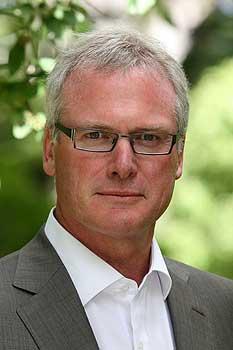
Aroha Heaslip from Evaluation Associates.

Vicki Spiers and Verna Littlejohn returned from an 'OTJ' workshop in Tauranga speaking very highly of a strong message presented by a quality presenter.  This is how I was introduced to Aroha.  


Aroha Heaslip
Evaluation Associates are a independent educational consultancy which is based in Auckland (Aroha heads the Tauranga branch).  Their main current contracts are focused on...

  1. Modern Learning Environments
  2. Assessment For Learning
  3. Maori Medium 
Aroha educational background is very wide, working in mainly in Secondary, with a little of Intermediate, Co-curricular and establishment of a full immersion Kura Kaupapa.  

The main message of today's presentation was around - having the learning as the 'captain' of their own education.  That being questioning how we can empower our students to be active navigators of their learning.  

What are the things that act as a barrier for students to operate with self efficacy in their learning?  Typically this will be specific limitations around the individual students level of literacy.  

What is our awareness as a community of students about the progression of akonga from our feeder schools?  What are the implications exist for those students if they arrive at Waihi College and 'start from square one'?  

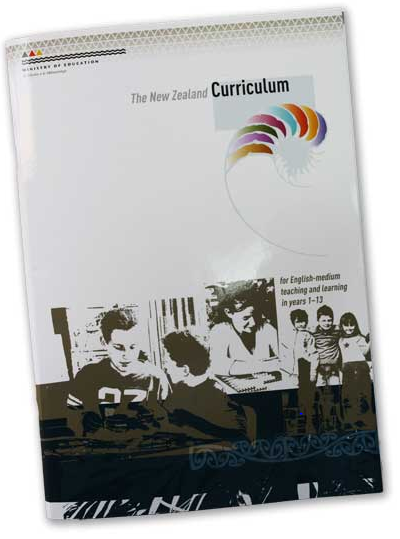
The reflection of the presentation is found in 'front end' of the NZC where 'Effective Pedagogy' is outlined; 


Aroha based much of her foundation of her discussion about what Waihi College presents in our prospectus and website about what is important in education here at school.  

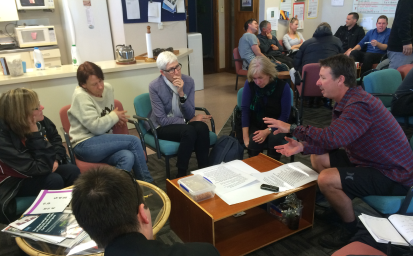
A core part of Aroha's workshops activities 'Coherence at Our School' - where staff divided into smaller groups and work through the shared understanding of how things are done here at Waihi College.  
  • How do we make available the information about our tamariki?  Can we sharpen up our lines of communication?
  • The use of exemplar materials - spelling out the steps through the curriculum.  Our teachers know what "level four" looks like - but do our students? 
  • How can we get the staff to act consistently in a student centered manner?  
  • How do we make explicit use of learning intentions and success criteria?  
  • What are the core learning that needs to be the basis of education here at Waihi College (example of the use of being able to write coherent paragraphs)?  
The latter part of the presentation we were presented with an open ended invitation - "What are the next steps that can be targeted for our community to move towards in the immediate future?"

  • More access to the information (say with a rotated option class) knowing a little bit more about the group before we have them. (Bob's group)  
  • How can we extend success some teachers are having with certain students to be shared success with all teachers? (Aroha's observation)  
  • How can we increase the parental/whanau buy-in to education? (Levonne's group)
  • Exemplars on the walls - students who say "why didn't I get a merit?" after the assessment - this should/could have been presented earlier to empower that student.  (Peter's group) 
  • We could be talking more between groups. (Bridget's group) 
  • Use of the APP's task being a more deliberate method of presenting shared understanding.  (Norm's group).
  • If we can't see it how can the kids?  (Jo's group)
  • How can we improve the collaboration with the feeder primary schools - can this proactively be acted upon? (Sean's group)
  • What about the 'uncontrollable' (e.g. truancy)... can our systems be improved?  How can we make our flagging of issues more ready actionable?  (Carlene's group)
  • Developing of Ako meetings - especially in the start of the year.  (Jay's group).
  • Shared rubrics/exemplars across the learning areas.  (Jay's group).
     
Archway of Teaching Capacity

n.b Aroha's presentation was through an online program called 'Sway' this is a free product available from Office 365. 

This post relates to RTC #7. "Promote a collaborative, inclusive and supportive learning environment."  And ERO's School Evaluation Indicators Domain 4 "Responsive Curriculum, Effective Teaching and Opportunity to Learn - students develop learning to learn capabilities."


Tuesday, September 1, 2015

What Is A Good Learner

Shared Understanding of Learning

We've all been there - sitting in the first week of a new school year looking over the class list/photo's thinking about those 30 odd students we've just met.

The honeymoon is a nice stage pretty much students are working on those first impressions.  Teachers are working on the 'don't smile until Easter'.  The students will be weighing up what sort of teacher they've got and teachers are thinking what kind of learners they've been timetabled.  What specifically is it that students are trying to project?  What characteristics are the teachers looking/hoping for?  

An interesting exercise has been to see if there is a shared understanding of whether students and teachers have the same ideas about what makes a good learner. 

An early staff meeting this term I presented the following presentation.


Part of this professional development programme was to survey staff on the characteristics of good learners.  I've also interviewed fifty students and asked them the same question.  

What was very interesting was that although there was much middle ground between what teachers and students viewed as good teaching there was very significant differences. 

Perhaps the most obvious difference was that the students view 'good learning' as physical actions; like 'listening' and 'neat books' or 'good test results'.  For teachers the most common view was the dispositions of mind 'collaborative' or 'determination'.  

I think that this is a valuable observation.  That our young people haven't yet thought deeper about education and their larger role in the learning.  I think that there are good messages that can move our students to a more empowered space as learners.  

This post relates to RTC #8. "Demonstrate in practice their knowledge and understanding of how ākonga learn - iii. encourage ākonga to take responsibility for their own learning and behaviour 
iv. assist ākonga to think critically about information and ideas and to reflect on their learning." 
And ERO's School Evaluation Indicators Domain 4 "Responsive Curriculum, Effective Teaching and Opportunity to Learn - students develop learning to learn capabilities."


Prime Minister Visit

John Key Comes to Waihi College

Today we had the surprise of hosting the Right Honorable John Key to Waihi College.  It is not often that a school gets to play host to the sitting Prime Minister.  After the recent weather the region turned on an excellent sunny day.

Mr Key was welcomed officially in a Year 7 - 10 assembly (and unofficially by anti-TPPA protesters) with a strong rendition of the national anthem.  Mr Cochrane introduced the Prime Minister to the junior school.  Mr Key presented information about life in political office, challenges of running a country and finished with engaging around the flag referendum.  He demonstrated his skills of persuasion by getting a significant number of students to change their minds about not changing the flag.  The Prime Minister was accompanied by local Member of Parliament for Coromandel Scott Simpson.

There were four students selected to ask Mr Key questions.  They were Khan Stevenson (Yr 10), Luke Barakat (Yr 9), Penny Croker (Yr 8) and Bess Humphreys (Yr 7).  The students displaying credible political nous for young students.
Mr Key with the student leaders.  

The official party moved through to the staffroom where Mr Key spent time with some student leaders, offering advice, answering questions, taking 'selfies' and even taking up the challenge of an arm wrestle from the head girl Kate Dunstall.


Mr Key, Mr Simpson and Mr Cochrane
presented the school calves unit by Mr Redwood.  

From there the final part of the visit was twenty minutes up at the College farm unit.  Mr Key spent time with seniors from the Urban Farming unit and juniors from the school calf club.  Needless to say that all of the delegation were suitably impressed with the quality of the education and what we get from our facilities here in Waihi.


This post relates to ERO's School Evaluation Indicators Domain 2 Leadership Condition for Equity and Excellence : "Leadership communicates and models clear and consistent social expectations to support teaching and learning."

Monday, August 31, 2015

Progress and Consistency Tool

Overall Teacher Judgements

The Ministry of Education has invested a great deal of time and money into an online computer program that is designed to help teachers make more informed judgments about what level the students are operating in the curriculum.  They call this program the PaCT which is Progress and Consistency Tool.  (Click here to go to the website)

As part of yesterday's Teacher Only Day programme the Year 7 & 8 teachers (and Junior Maths teachers) were introduced to this tool.  It was pleasing to see teachers become early adopters of this technology.

Some of the benefits of the PaCT system include...
  1. Automatic communication with Kamar - the two administration systems sync together.
  2. The individualised nature of PaCT where each student is individually judged.
  3. The multiple illustrated exemplars (with teacher-student dialogue) make for very clear indications of where in the spectrum students consistently sit.
  4. These illustrations become a good check point for staff to reflect upon the level of the class.
  5. The entire cohort data will be available to better allow for monitoring and planning around year levels.  
One of the comments was that with greater awareness of the PaCT tool that there will be an increased level of consistency around overall teacher judgments between teachers, schools, and different years which can only be beneficial.  

 This post relates to RTC #11. "Analyse and appropriately use assessment information, which has been gathered formally and informally - i. analyse assessment information to identify progress and ongoing learning needs of ākonga." And ERO's School Evaluation Indicators Domain 4 "Responsive Curriculum, Effective Teaching and Opportunity to Learn - Effective Assessment for learning."

Sunday, August 30, 2015

Year 10 Conference

Conference Flyer
Owning Your Future

Today our year ten students spent the day out of school at the Waihi Academy on conference.  This inaugural annual event is the brain child of Learning Leaders Jo Howell and Vicki Speirs.  The purpose here is to take a break from the regular routines of school life and present a days worth of workshops and keynote addresses from former Waihi College students.  


Introduction of Keynote
Year 10 was chosen as this represents a key age in adolescence where students have been through the institution of school but now viewing the world with increased maturity.  We have timed this conference to be just ahead of subject selection for the first year of NCEA Level One.    
Seven ex student leaders from previous years at Waihi College made the presentations and keynote address (which was given by Adrian Holmes).  

Those students included...
  1. Adrian Holmes (class of 2003)
  2. Anna O'Hagen (class or 2008)
  3. Samanatha Sanderson (class of 2011)
  4. Tina Youngman (class of 2001)
  5. Natasha Staheli-Lowe (class of 2012)
  6. Jack Kingsford (class of 2011)
  7. Ariana Te Wake (class of 2005)

Our hope is that from today many future dreams would have been formed and that our students will see the next three years (plus) at Waihi College as being an avenue to launch their futures.  

It is vital that I acknowledge the excellent efforts of Jo Howell and Vicki Speirs who's collective efforts and initiative brought together a brilliant day.  Tremendous thanks also goes to Tony Kang and the staff at Waihi Academy for providing a fantastic venue and delicious meals.  

This post relates to RTC #2. "Demonstrate commitment to promoting the well-being of all ākonga."  And RTC #7. "Promote a collaborative, inclusive and supportive learning environment".  And ERO's School Evaluation Indicators Domain 6 Knowledge Building for Improvement and Innovation "Participation in evaluation, inquiry and knowledge building activities contributes to changes in thinking and behaviour and builds inquiry 'habits of mind' ".

Thursday, August 20, 2015

Classroom Expectations

Evolution of Education

When I first began teaching I was *taught* a very traditional way of managing a classroom.  The basic presumptions were...

  1. That getting students to work was the key to learning.
  2. Work looked like silence, lots of writing, solo participation.
  3. That students would actively look to doing minimal work.
  4. Teachers were to pressure students into doing the work.  

The following PowerPoint presentation begins with some photographs which sum up that philosophy on education.  The dog with a biscuit on his nose - this can be done by training that the dog (aka the student) would want to eat straight away (not work in class) and the owner (aka teacher) would have to be in control.  


The other image of an alpha wolf represents the way teachers were modeled to control.  That you would rigidly police the students into obedience.  This was often done through faking aggression - don't smile until Easter on steroids.  


Classroom Expectations from WaihiCollege

The video which I showed echo'd this management style...


Looking at this video what messages were represented?

  • Discipline?  Humiliation?  Inhumanity?
  • Education centered on facts?
  • Education centered on the teacher?
  • Misogyny? 
One of the things that you may have missed in this clip.  This is about the older teacher showing the new teacher 'how it is done'.  

The evidence now is very clear - the best teaching is done in an environment where mutual respect is paramount.  Todd Whitaker puts it very well in his book (click hereWhat great teachers do differently; “The teacher who sets a positive tone can influence the interactions of everyone in the school” (p. 55)

This post relates to RTC #2. demonstrate commitment to promoting the well-being of all ākonga.  And RTC #7. promote a collaborative, inclusive and supportive learning environment.  And ERO's School Evaluation Indicators Domain 4 Effective Teaching "Students experience an environment in which it is safe to take risks and errors provide opportunities to learn".  

NASDAP Conference 2015

Thoughts from Conference


I had been looking forward to this year's Deputy Principal's annual conference.  The theme for this year was 'Disobedience - Jump out of the safe zone'.  The idea being that we should be avoiding getting comfortable in our roles and how our schools sit in education.

The conference was extremely well attended with approximately 350 senior managers from around the country.  The bi-annual conference is a nationwide event covering all the regional areas.  This year was held at Skycity.  

During this conference there was a consistent theme about questioning the perceived limitations of schooling, curriculum and traditional assumptions around education.  This was, naturally, a theme eagerly grabbed by our key note speakers.

I very much enjoyed the speech by Mai Chen who presented an excellent summary of education from the perspective of a parent.  Her story of immigration to New Zealand as a six year old and inevitable rise in Law whilst inspirational was grounded in the nitty gritty of life. 

Mai presented her notion of 'disobedience' as deliberately avoiding getting too comfortable with life.  That when we're overtly familiar with our surroundings and systems that we should "choose which tiger to throw a stone at".  

Nathan Makaere Wallis was another keynote speaker who I found to be excellent.  I have already posted a entry on his ideas (click here).  For me Nathan's core message was about getting young people to cognitively process their ideas/actions/words prior to decisions.  He illustrated this well by describing sitting with a young person and going through the 'game' of "what would you do if insert idea happened?"  The notion being that rehearsal.  [Nathan is coming to speak at the college on the 22nd of next month].  
  
The third keynote address I enjoyed greatly was by Steve Maharey (former Education Minister and current Vice-Chancellor of Massey University).  He presented a very good synopsis of what are the key characteristics of those students who will thrive in the future (critical thinking, self management, collaboration, innovation etc).  

This post relates to RTC #4. "Demonstrate commitment to ongoing professional learning and development of personal professional practice - ii. participate responsively in professional learning opportunities within the learning community." And ERO's School Evaluation Indicators Domain 2. "Leadership promotes and participates in a coherent approach to professional learning and practice."
Know Thy Impact

As a part of a series of workshops on Visible Learning Plus (the supplementary material for John Hattie's seminal work).  This is the presentation that was made to staff in our afternoon meeting.  

The purpose here is to form a collective understanding of the shared practice here at Waihi College around use of assessment information.  

Being a teacher who uses quality data to inform our practice is a vital component of modern teaching.  But there is a genuine plethora of data available to staff and this can create issues around sifting through this information.  

Here is the powerpoint that was presented.  The key points are...


  1. Teachers should be responsive to the students needs. 
  2. We should be self reflective on our practice (are we making the difference - having an impact).
  3. There are a variety of types of assessment - each with their own purpose.  We should be using the full gambit to inform ourselves.
  4. This ties very well into 'Teaching as Inquiry' - which is a core component of our appraisal system and the Registered Teacher Criteria.  


Know thy impact 10th august 2015 from WaihiCollege


Here is a copy of the video that was presented. 

This post relates to RTC #6  "Conceptualise, plan and implement an appropriate learning programme." And RTC #8. "Demonstrate in practice their knowledge and understanding of how ākonga learn- i) enable ākonga to make connections between their prior experiences and learning and their current learning activities & iii) encourage ākonga to take responsibility for their own learning and behaviour."And ERO's School Evaluation Indicators Domain 4. "Assessment activities are inclusive, authentic and fit-for- purpose, providing relevant and meaningful evidence to evaluate the student's achievement and progress."